Free
Millions of years ago, the Upper Mississippi River flowed north and emptied into a big lake. Then came the Ice Age.
From about 3 million to 10,000 years ago, the North American continent was covered with ice over and over again. Ice came as far south as the land around the Ohio River. Then Earth started warming up. The glaciers slowly started melting. They left behind lots of rocks and dirt they had brought with them. This material dammed up old river valleys. It created the Great Lakes. It also forced rivers to find new ways to the sea. The Mississippi found a new course southward. Today, more than 12 million people live along this river.
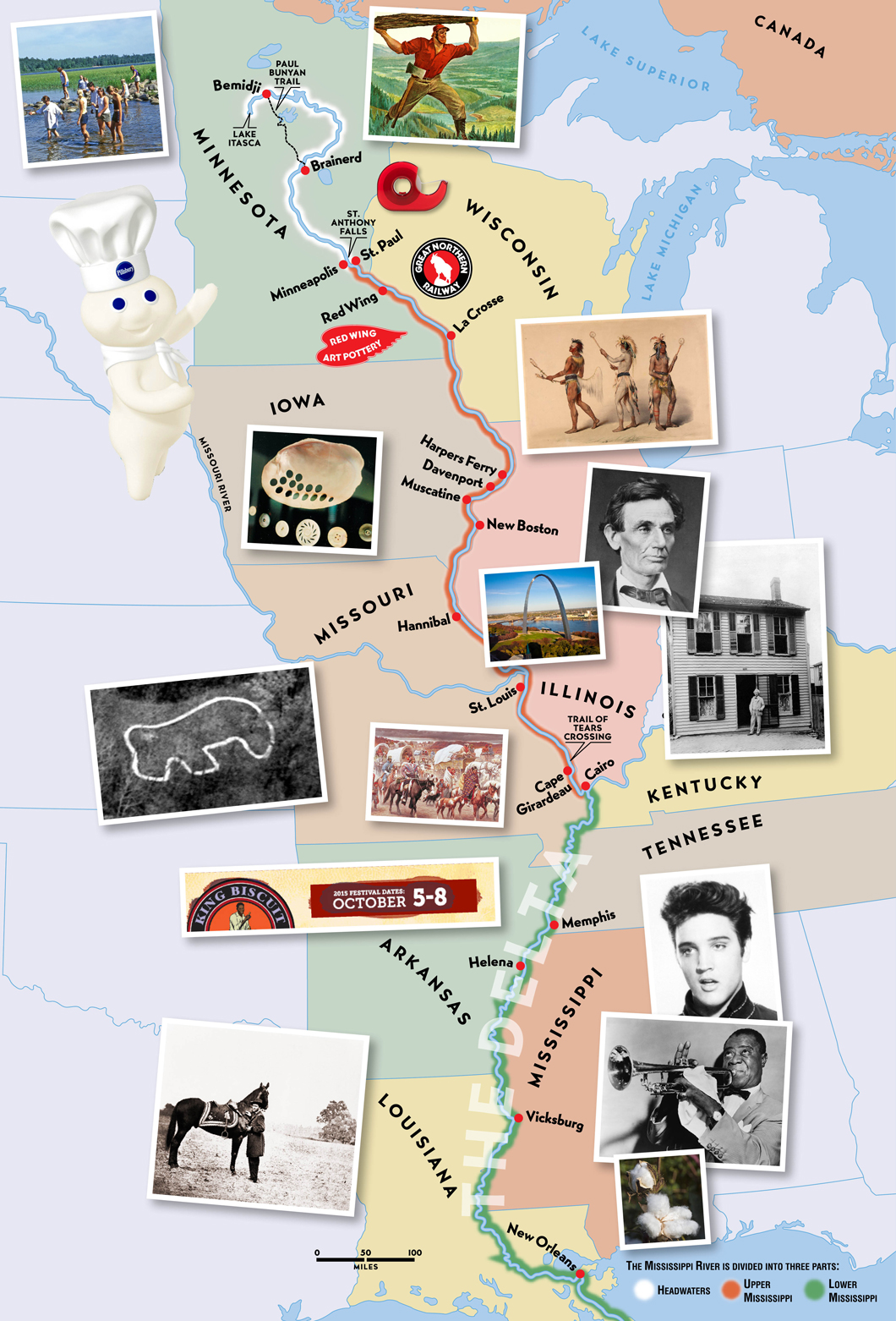
Paul Bunyan Trail
Lumberjacks worked in these north woods. They created the legend of Paul Bunyan and Babe the Blue Ox.
Lake Itasca
This is the source of the Mississippi. The word “Itasca” comes from the Latin words veritas caput, which translate as “true head.”
St. Paul
Railroads made St. Paul the ”Gateway to the Northwest.” St. Paul was also a major port. It was the northern end of the line for commercial river traffic. Scotch Tape was invented here.
Minneapolis
Companies like Pillsbury and General Mills got their start here. They used the water power of the Mississippi to mill flour. Minneapolis is the home of the Pillsbury Doughboy.
St. Anthony Falls
This is the river’s only natural waterfall.
Red Wing
This city is named after the Sioux chief Red Wing. His headdress is said to have been made of swan wings dyed red. Red Wing is famous for its household pottery.
Muscatine
This city was known as the Pearl Button Capital of the World. In the late 1800s, it was filled with button factories. The buttons were made from the shells of pearly mussels found in the Mississippi.
La Crosse
This city is named after the game of lacrosse. That’s because French explorers saw Native Americans playing the game here.
St. Louis
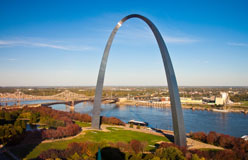
Before heading out, explorers, fur traders, and pioneers bought supplies here. Now the city is home to the Gateway Arch. It was built in 1965. It honors St. Louis’s historic role as the “Gateway to the West.”
Harpers Ferry
Effigy Mounds National Monument contains prehistoric burial mounds. They date back to 600 B.C. Many of these mounds are in the shape of a bird or bear. They are the remains of mound-building Native American cultures.
Cape Girardeau
Cherokees crossed the Mississippi just north of this city when they were on the Trail of Tears (1838–1839). They had been driven out of their homes in Georgia and eastern Tennessee.
Helena
This city is tied to the river by cotton, soybeans, and rice. Helena’s farms average in the thousands of acres. It is also the home of the King Biscuit Blues Festival.
New Boston
Before Abraham Lincoln was U.S. president, he worked as a surveyor and measured the lots that this town was built upon.
Hannibal
This was the boyhood home of author Mark Twain. It inspired the setting of The Adventures of Tom Sawyer.
Vicksburg
During the Civil War, Union forces captured Vicksburg. This was thanks to the military genius of General Ulysses S. Grant. Having the city gave the Union control of the river north of it.
Memphis
This city was a major trading center for cotton and lumber. Memphis later became known as the home of the blues. It is also Elvis Presley’s hometown.
New Orleans
This city is the birthplace of jazz. Musician Louis Armstrong was born here, too. It is also the home of the annual Mardi Gras celebration. Its unique Cajun and Creole cultures are a blend of French, Spanish, African, and other heritages.
The Delta
The area south of Cairo, Illinois, is known for its rich soil. It was home to many cotton plantations.
Davenport
This is the site of the first railroad bridge to be built over the Mississippi River. It was built in 1856.