Free
The September 11 attacks resulted in 2,977 deaths and thousands of injuries.
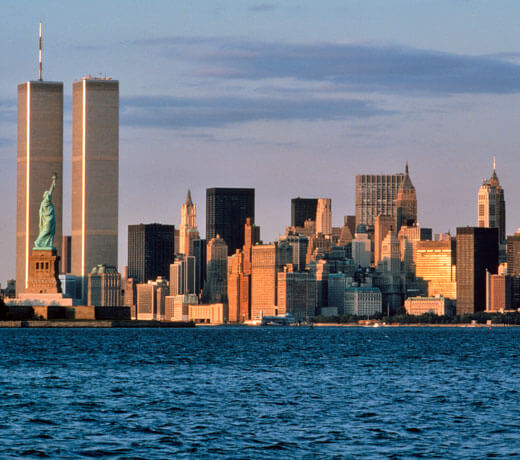
This includes the attacks in Manhattan, Washington, D.C., and Shanksville, Pennsylvania. It does not include the jijackers. Thousands of small businesses in and near the World Trade Center were destroyed. The attacks caused $60 billion in damage to the site itself. That includes the subway that runs below it. It also includes nearby buildings and roads. Plus, $1 billion in damage to the Pentagon. Almost 2 million tons of debris had to be removed from Ground Zero.
The whole country was in shock.
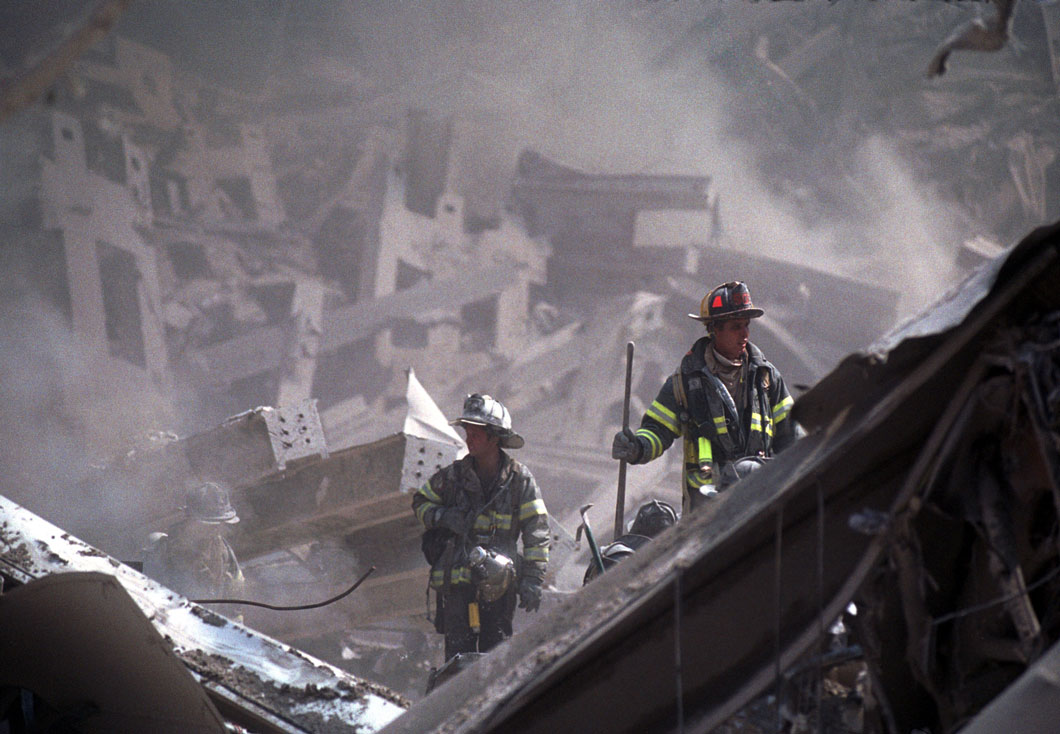
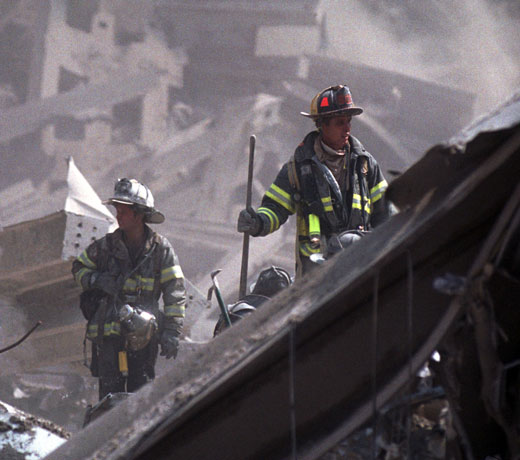
▲ Almost 3,000 people lost their lives in the attack. Of them, 343 were New York City firefighters. Plus 23 members of the New York Police Department and 37 Port Authority police. (In New York City, the Port Authority is a public agency. It has authority over the World Trade Center.) Known as first responders, these are the people who entered burning buildings to save the lives of the people inside. Their courage and bravery – along with the courage and bravery of first responders who survived – make them true heroes. Here is part of an audio transcript of Port Authority officer Adrienne Walsh’s experience as she told it to the 9/11 Memorial & Museum project.
You could see Manhattan and then not see Manhattan, and all of a sudden I looked up and there was just this explosion of confetti in the air . . . I thought, ‘That‘s bizarre.’ It was a tremendous amount of paper.
And I remember when you got to City Hall . . . it’s almost as if it was a curtain, and you walked into a curtain. The sky disappeared. There was air and bright light on this side, and there was just gray dust that you could barely see on this side. It was just like walking through a theatrical curtain. There’s this six inches of dust on the ground.
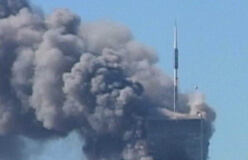
But I saw what I can only describe as almost like a tornado hurtling at me. Just this cloud of dust that had to be over 100 feet in the air, and it was literally circling, and it was just bearing down. I mean, I’d never seen anything like that and anything move as fast as that.
◀ For all the people who lost their lives on September 11, there were people who survived as well. Jonathan Weinberg was one of them. Weinberg worked in the South Tower of the World Trade Center. Here is part of his story, as he told it several years after the attack.
I was standing in the hallway outside my office . . . when I heard a tremendous explosion at 8:46 a.m. I looked into my office . . . and saw a gaping hole in the south side of WTC1. We had no idea what had happened.
At 9:03, I felt a violent jolt and then a falling sensation. I remember thinking that the building was coming down. . . . I found myself outside my office with a number of co-workers. There was tons of dust and debris in the air and the electricity was out.
We slowly made our way down the 77 flights of stairs. At some point, I remember passing a number of firefighters heading up the stairs. They had a full set of gear on, and they looked weary and frightened, yet they continued up past us. It’s hard to put into words what I feel for the firefighters who sacrificed everything that day in order to try to help others. Reverence is about as close as I can get.
I recall thinking that we were . . . basically were out of danger. It was then that I saw police officers or firefighters yelling and waving at us frantically to get out of the building.
We began walking north. We had gotten maybe five blocks away when we heard a large rumble and saw a massive dust cloud to the south of us from the direction we came. Word eventually filtered up through the crowd that WTC2, where my office resided, had just fallen.
Trinidadian-born Genelle Guzman-McMillan was the last survivor rescued from the ruins of 9/11. For 27 hours, she lay in the rubble of the collapse. Her left hand was the only part of her body free to move. One of the 300 specially trained search and rescue dogs found her. Guzman-McMillan described the experience and her thoughts about it in a book. ▶
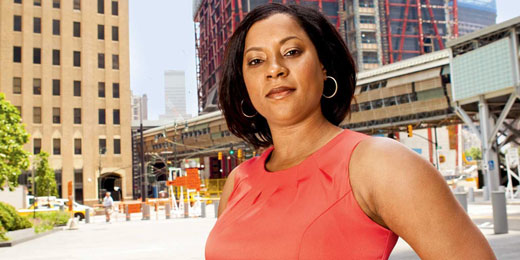
This tragedy was a wake-up call for me because it transformed me into a much better, caring person, and I’m just forever grateful to be part of this new life.
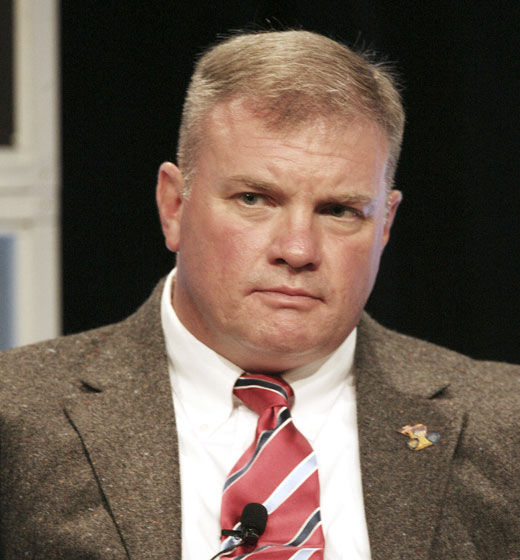
◀ On September 11, New York City Fire Department Deputy Chief Jay Jonas attempted a search and rescue in the North Tower. Talking to those under his command, Jonas recalls what he said. “Here’s the deal. It’s a raw deal. But this is what we have to do. . . . We have to go upstairs in this building for search and rescue.” They made it to the 27th floor. Then conditions made it impossible to continue. So they turned around. He recalls, “We continued down the stairs and we got [to] the 20th floor and we saw a woman standing in the doorway crying . . . she had made it down from the 72nd floor and now she couldn’t walk anymore . . . so I said bring her with us even though we ourselves were in retreat and trying to save our own lives.” Jonas was trapped on the fourth floor when the tower fell. But he was able to make it out alive.
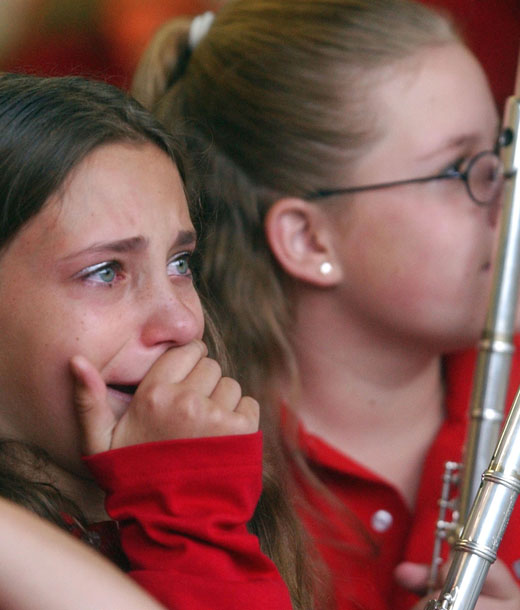
Children were affected by the events of September 11 just as adults were. Especially children living in New York City. Amanda Mummery was a fifth grader at the time. She spoke with an interviewer from the American Folklife Center (Library of Congress). “Everyone got really scared because some parents worked in the building. . . . Everyone was kind of shaky [on Thursday when she returned to school] and that’s all we were talking about. . . . I think in the beginning it was like disbelief . . . and after it was sort of sinking in and that’s when it got really scary in the next few days. . . . I kind of hope that they catch the terrorists and I’m kind of scared to go anywhere. . . . It’s still a little scary coming and going. . . . I think that a lot of people are kind of depressed and worried about things that are out of the ordinary. Some people said they were having really scary dreams. On the whole people are saying they have to go on.” ▶