Free
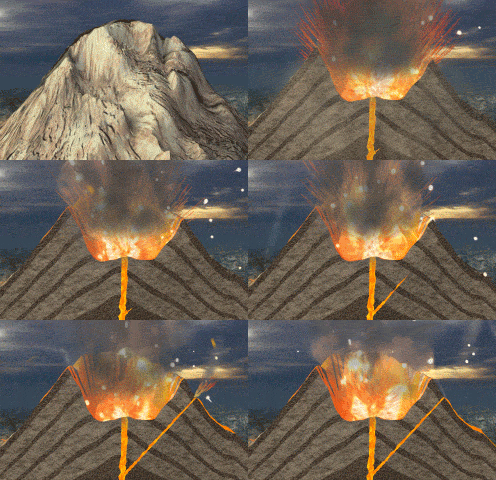
Volcanoes are like sleeping giants. After years or even centuries of resting, they wake up—and they erupt.
Some powerful eruptions blow the tops off mountains, flatten out forests, and dam up rivers. Some eruptions have killed tens of thousands of people. A few eruptions have buried cities, and others have buried mountains. Some big eruptions have even changed the world’s weather for years.
Volcanoes also play a role in shaping the Earth. Their activity builds islands, mountains, plains, lakes, and the ocean floor.
Despite the dangers of active volcanoes, people often live near them. Farmers like the soil volcanoes create. Some of our favorite foods—like chocolate—come from plants that grow best in volcanic soil.
Come learn about volcanoes—on land, under the seas, and in outer space.
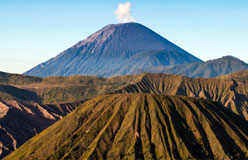
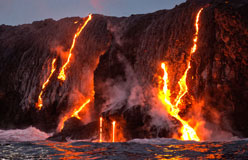
The word volcano comes from Vulcan, the Roman god of fire. Volcano means the hole in the ground through which lava erupts. It also refers to the mountain that the lava builds. ▶

▲ An active volcano is erupting, or has erupted since written records were kept. A dormant volcano is active, but it is sleeping. Scientists expect it to erupt some time in the future. An extinct volcano is not expected to erupt ever again.


▲ Mauna Kea is the Earth’s tallest mountain. It rises more than 33,000 feet from the ocean floor, but you can see only 13,796 feet above sea level. Mount Everest is 29,035 feet high, but you can see all of it.

The volcanically most active place in our solar system is not on Earth. It’s on a moon of Jupiter known as Io. Volcanoes have made Io’s surface so blotchy, it looks a bit like a pizza. ▼


Check It Out!
Who is the Man in the Moon?
Contrasts between light and dark areas on the surface create the “Man in the Moon.” The darker areas are lava flows. Most of them fill craters left by meteorites that hit the surface. The lighter areas are highlands, which don’t have many dark-colored volcanic rocks.