Free
Washington, D.C., is full of monuments and memorials to special people and events in U.S. history.
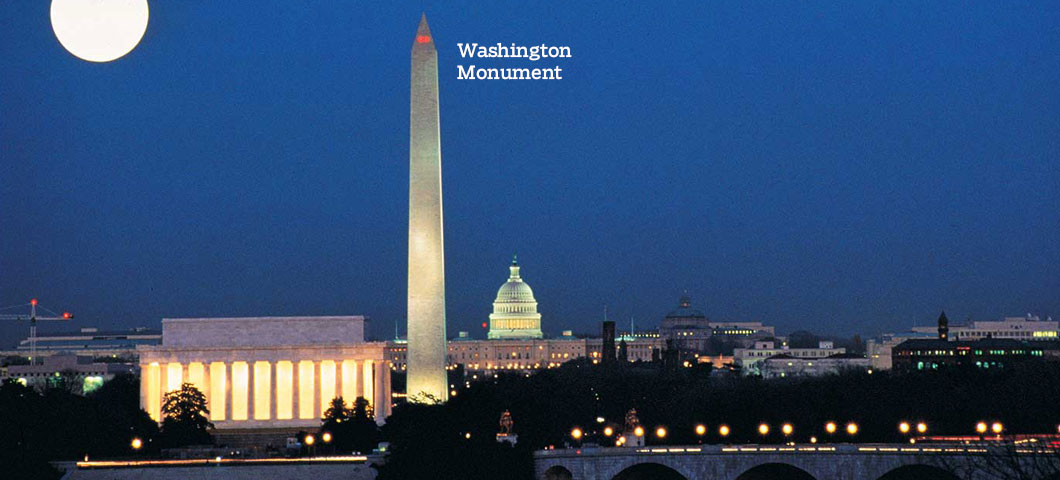
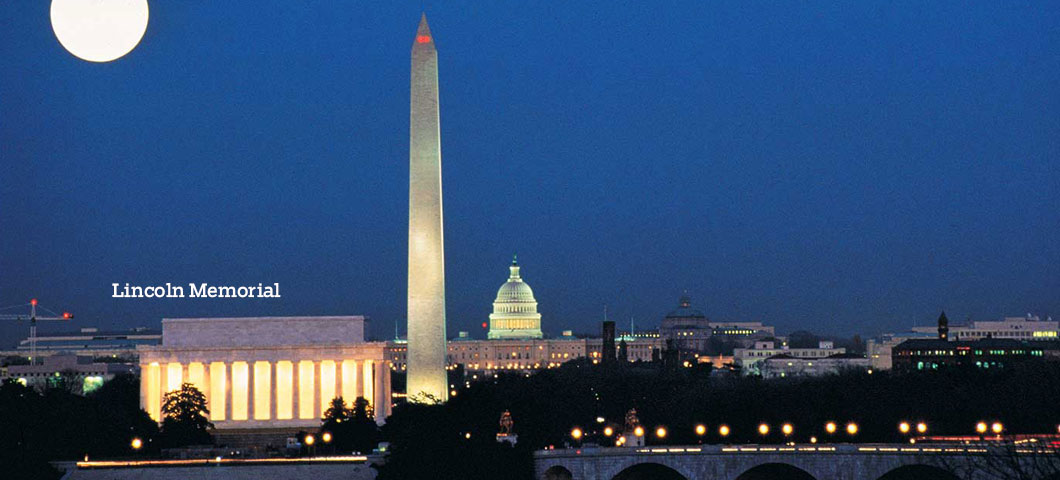
Monuments and More
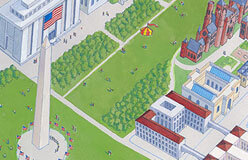
At 555 feet and 5-1/8 inches, the Washington Monument is the tallest masonry (stone, brick, or concrete) structure on Earth. It’s also Washington’s only skyscraper. The monument was begun in 1848 with private funding. Construction stopped when money ran out in 1860. Author Mark Twain said the uncompleted monument looked like “a factory chimney with the top broken off.” When the monument was finally finished in 1884, the steam elevator was considered too risky for women and children, who had to walk up the 896 steps. Today everyone must take the elevator to the top, but you can take a 45-minute tour walking down.
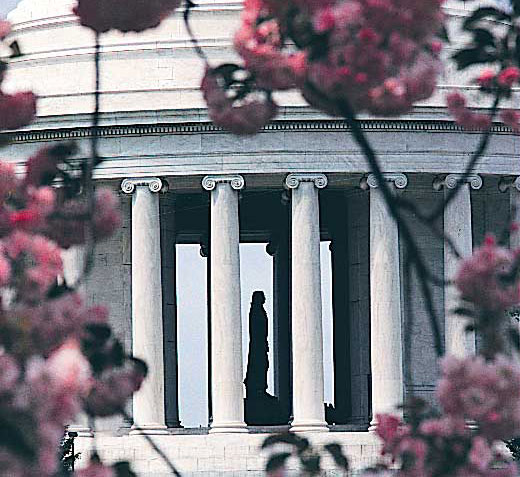
▲ This memorial to Thomas Jefferson, the nation’s third president and the author of the Declaration of Independence, was completed in 1943. That was the two-hundredth anniversary of his birth. When plans were announced to build the memorial on the Tidal Basin, protesters chained themselves to the Japanese cherry trees for fear they would be destroyed by the construction. In fact, only a few trees were lost.
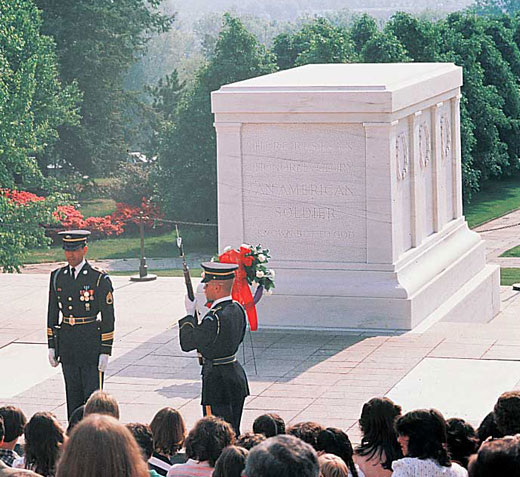
▲ Arlington National Cemetery, across the Potomac River from D.C., is the burial place of more than 400,000 veterans and their dependents. The Tomb of the Unknowns honors the U.S. war dead. It contains the bodies of four unidentified soldiers, one each from World War I, World War II, the Korean War, and the Vietnam War. At the tomb, a soldier stands guard around the clock.

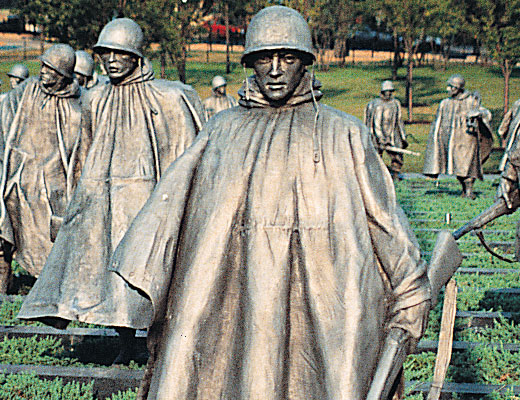
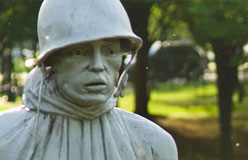
◀ The Korean War Veterans Memorial includes 19 ghostly gray sculptures of soldiers in ponchos advancing across a field. Also featured is a black granite wall with a mural of support groups, such as nurses.

◀ The Vietnam Veterans Memorial is a V-shaped wall of polished black granite. It is inscribed with the names of the nearly 60,000 U.S. military personnel who died or were declared missing in action in Southeast Asia between 1959 and 1975. Some visitors leave flowers, war medals, notes, and pictures near specific names. Maya Ying Lin, a 21-year-old student at the time, won a national contest to design the memorial. Even though she earned only a B– from her art professor, her work proved to be one of the city’s most successful monuments. Attendance is higher there than at any other memorial.
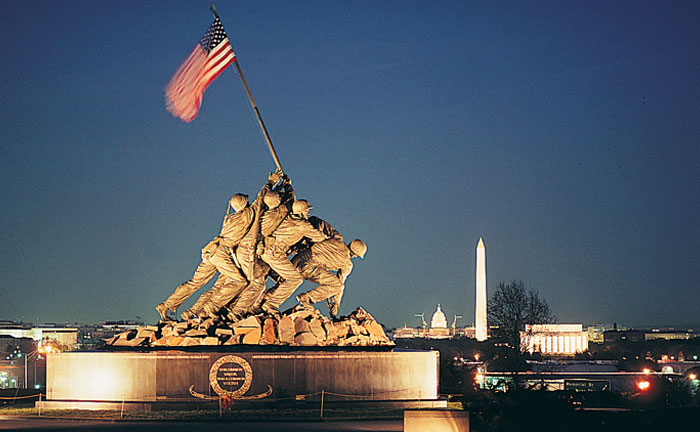
▲ During World War II, a group of marines struggled heroically to raise the U.S. flag atop Mt. Suribachi on the Pacific island of Iwo Jima. A photographer caught the stirring moment. Later, the scene was portrayed in the largest sculpture ever cast in bronze. It stands in Arlington National Cemetery as the U.S. Marine Corps War Memorial.
Think Piece!
Suppose you could design a monument to honor some person or event in U.S. history. Who or what would you memorialize? What would the monument look like? Where in Washington, D.C., would you place it?
Loading the player...