Free
It’s 1865. Professor Édouard René Lefebvre de Laboulaye is giving a dinner party at his home near Versailles, France.
He is an expert on the history of the United States, where the Civil War has just ended. Laboulaye is glad that the Union won and slavery has been abolished.
Then the conversation turns to politics. The guests recall how the French had sent soldiers, arms, ships, and money to the U.S. That helped the colonists gain independence from Great Britain. They remark on the long-standing friendship between the two nations. They also talk about their shared love of freedom. After all, between 1789 and 1792, the French had also fought for their freedom in the French Revolution and overthrown King Louis XVI.
Suddenly, Laboulaye has a surprising idea. Why not honor the ideal of democracy and build a monument as a gift from the people of France to the people of the U.S.?
That was the beginning of what would become a 21-year labor of love. That surprising idea became the most powerful symbol of freedom in the world.
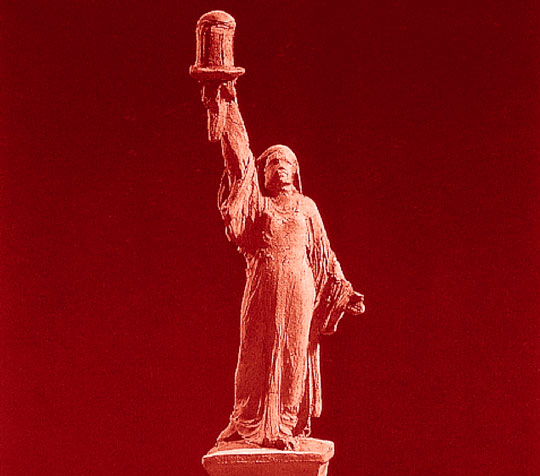
In the late 1860s, Bartholdi designed a huge lighthouse for the entrance to the Suez Canal. He called it Egypt Carrying the Light to Asia. The lighthouse was never built, but the model showed how the Statue of Liberty might look. ▶
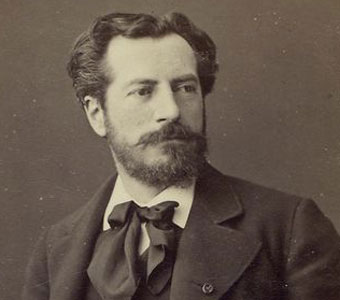
◀ One of the guests at that party was Frédéric-Auguste Bartholdi, age 31. He was already a well-known sculptor in France. He loved the idea of creating a monument to celebrate the ideal of freedom and the friendship between France and the U.S. Bartholdi became obsessed with turning that dream into a reality.
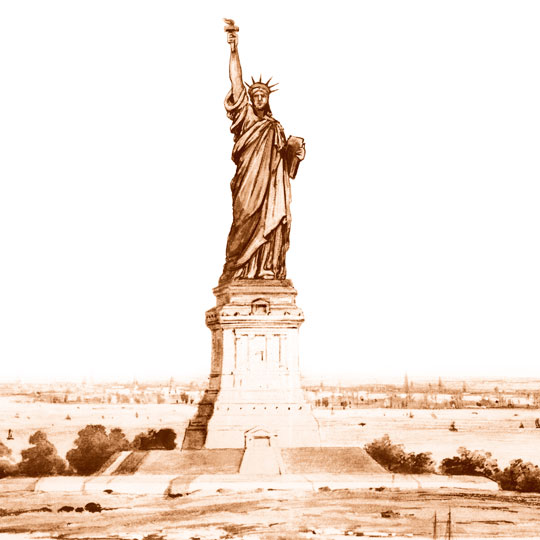
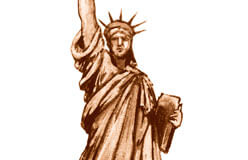
▲ Here is Bartholdi’s sketch of the Statue of Liberty, which he drew in 1883.
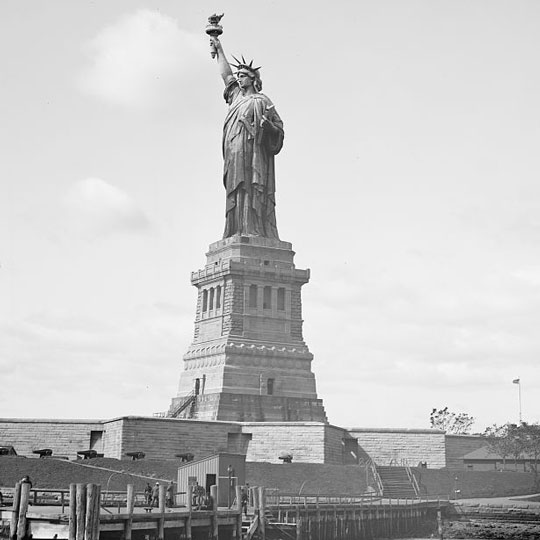
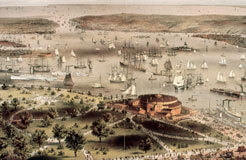
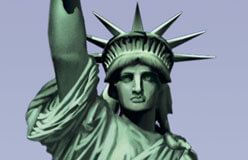
▲ The Statue of Liberty is a worldwide symbol of freedom and hope. It welcomes all who enter New York Harbor. When completed in 1886, it stood 305 feet tall and was the tallest structure in New York City. This photo was taken in 1890.
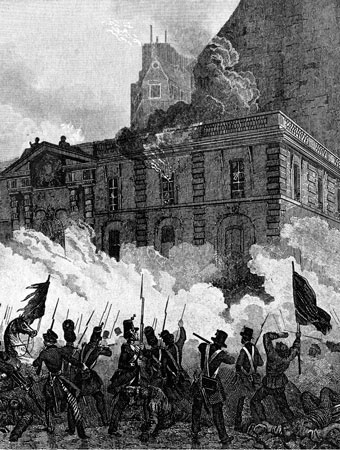
Both the American Revolution and the French Revolution were fought for the ideals of freedom and equality. The U.S. achieved its goal. It formed a government of the people, for the people, and by the people, where representatives elected by the citizens make decisions. The French, on the other hand, became involved in a long, bloody civil war. It was known as the Reign of Terror. That was followed by decades of political upheaval.