Free
What do airplanes, helicopters, ships, and submarines have in common? If you said they’re all forms of transportation, you are right.
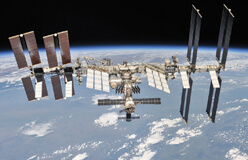
These things are all rigid, or solid, objects that move through fluids. That is the focus of aerospace and marine engineering. (In engineering, a fluid is not just a liquid like water. It can also be a gas like air.) Aerospace engineers try to answer questions such as: What is the best shape for a plane? How much fuel will it need to reach its destination? How do we design for a zero-gravity environment? Marine engineers — you guessed it — work with travel on and in water.
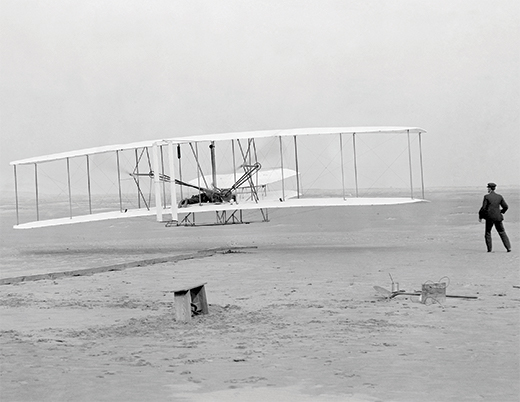
▲ In 1903, Orville Wright made the first successful flight in an aircraft with a motor. To do that, the Wright brothers had to answer three questions. How should the wings be shaped? What kind of engine does it need? How can the plane be balanced and steered? The brothers learned from the work of people who came before them. They also spent years modeling, testing, and improving their own ideas.
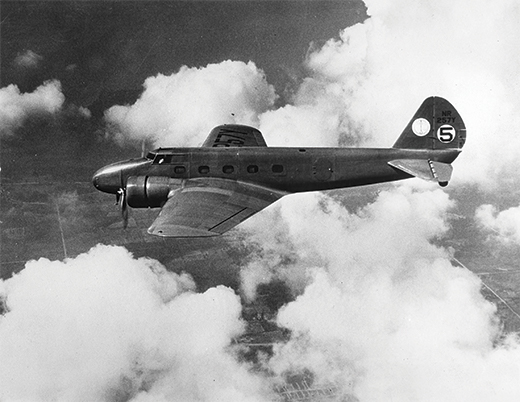
▲ The first modern commercial airplane was made in 1933. The propellers sent streams of air over the wings. The air moved the plane forward. Passengers in propeller planes had to put up with a lot of noise and vibration.
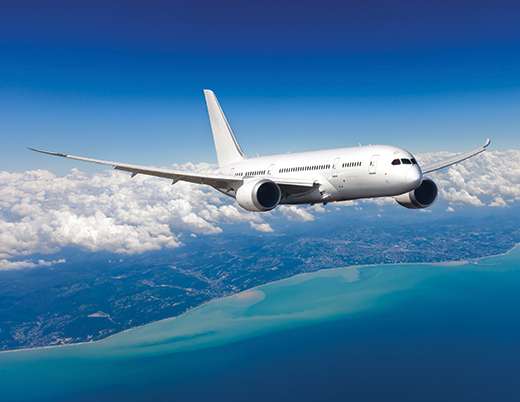
▲ To reduce noise and vibration, engineers developed the jet engine. Fans suck air into the jet’s engine, and the air mixes with fuel. The fuel burns, and hot gases are forced out the back of the engine. It’s like how a balloon flies forward when you let air out the back. The air forced out the back of a jet engine moves the plane forward.
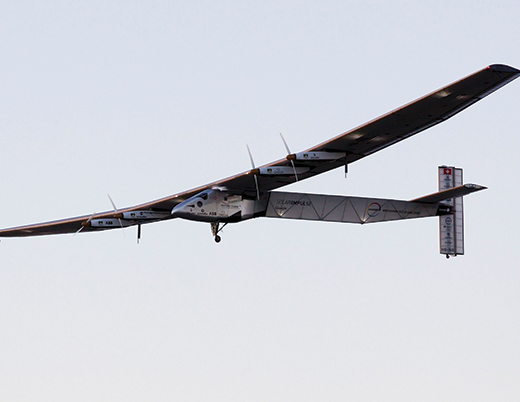
▲ Solar panels are used to heat homes. Can they also be used to power airplanes? Engineer André Borschberg tried it. He and other engineers spent years testing and refining his solar-powered plane. In 2016, Solar Impulse 2 made a 26,000-mile trip around the world. It used no fuel at all.
Think Piece!
Think about how an airplane and a car are alike. Why might aerospace engineers work on the design of both?
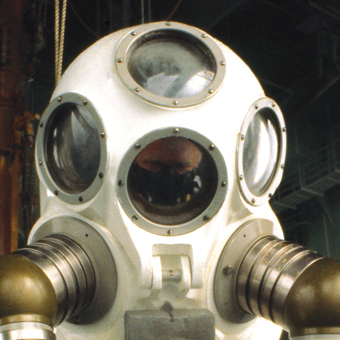
JIM Suit
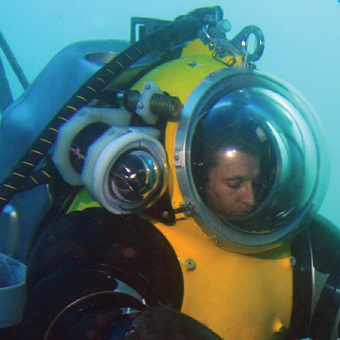
Newtsuit
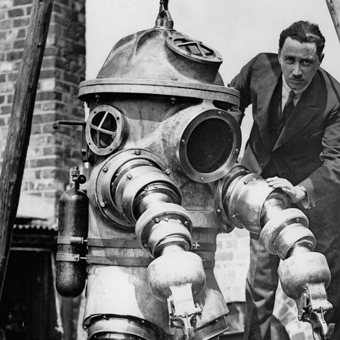
Armored Suit
▲ For centuries, marine engineers and others have worked on ways to explore the ocean. Their inventions range from diving suits to submarines. They’ve had to answer a lot of questions. For example, how can we keep oxygen levels safe? Deep in the ocean, atmospheric pressure is much higher than on land. How can we protect divers that far down? Some answers have helped improve diving suits. The suits have breathing systems that last up to 48 hours. They can keep divers safe down to 1,000 feet. Other answers have led to nuclear-powered submarines. They can go for 30 years without refueling. (But the crew still needs to eat. So they have to come up!)

Kids Discover talked with aerospace engineer Bridget Berry.
KD: What kinds of projects do you work on?
Berry: I’m on a team of engineers who design, build, and manage the monitoring of satellites after launch. One of my projects is a satellite that transmits information about location, timing, and position.
KD: What is the first thing you do when you start a new project?
Berry: I ask a lot of questions so I clearly understand the goal and the restrictions I have to work within.
KD: Can you share an anecdote about something unusual that happened during a flight
Berry: I remember once when we figured out a new way to use a satellite with broken parts to keep it from becoming space junk and also extend its life.
KD: What is something most people probably don’t know about your work?
Berry: Since we can’t visit a spacecraft once it’s launched, we’ve designed graphs to help us understand how it’s performing. During a complicated maneuver, all the engineers are staring at their computer screens to keep tabs on the satellite. It probably looks boring, but we’re all sitting on the edges of our seats, watching the data to make sure there aren’t any problems.