Free
Imagine this: It’s morning, and you’re getting dressed for the day. As you put on your sneakers, one of the laces breaks.
You could toss out the shoes, but other than the broken lace, they’re in good shape. Several possible solutions come to mind. You could knot the two parts of the broken lace together. You could glue them together. You could re-lace the shoe using only the longer part of the lace. You try and test the ideas until you find the one that works best. Welcome to the world of engineering – using what you know to invent, design, and build things that solve problems.
THE DESIGN PROCESS
Design a car. Create a perfume. Write software. Engineering is part of all these tasks and more. As with most professions, engineers — the people who do the work — specialize. But whatever their specialty, all engineers engage in the same process — the design process.
STEP 1
Identify a problem or a need.
Suppose you’re ice-skating on a cold winter afternoon. You buy a cup of hot chocolate to warm up. The drink is so hot you quickly put it down. As you do, the chocolate spills and burns your fingers. And there you have it, a need — a paper cup that’s safe for hot drinks. ▶

STEP 2
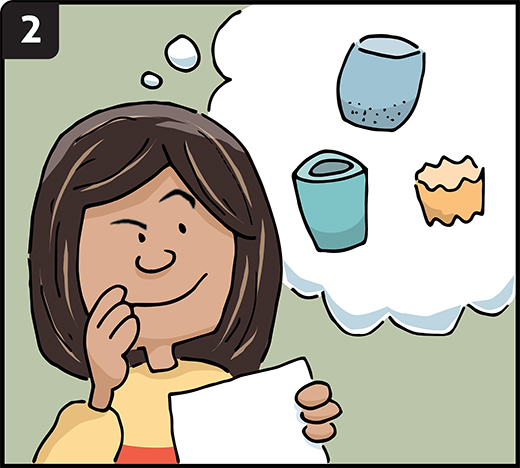
Brainstorm solutions.
◀ Several solutions come to mind. The cup could be made from foam, a material that doesn’t conduct heat. It could be made of thicker paper to absorb more heat. The cup could have a sleeve, something that slips on and off.
STEP 3
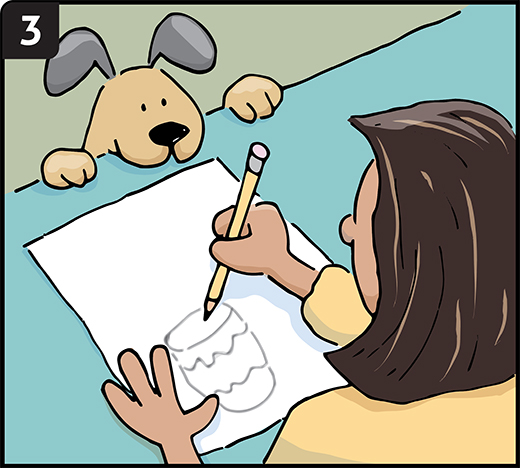
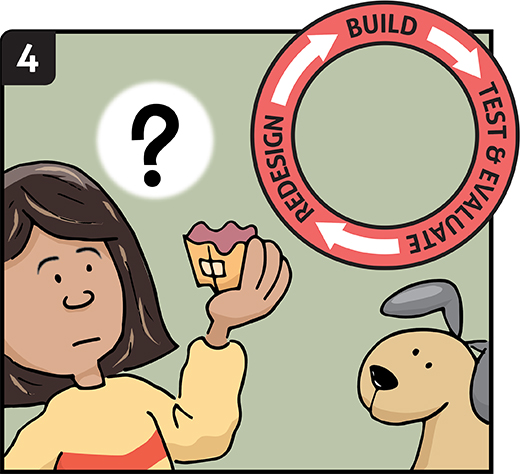
Pick the best solution and design it.
Foam cups would pile up in landfills and take a long time to decompose. Not a great idea. Thicker paper would make the cups hard to stack. Not great either. A sleeve is small and can be used only when needed. This seems like a good idea, so you sketch it and plan how to build it. ▶
STEP 4
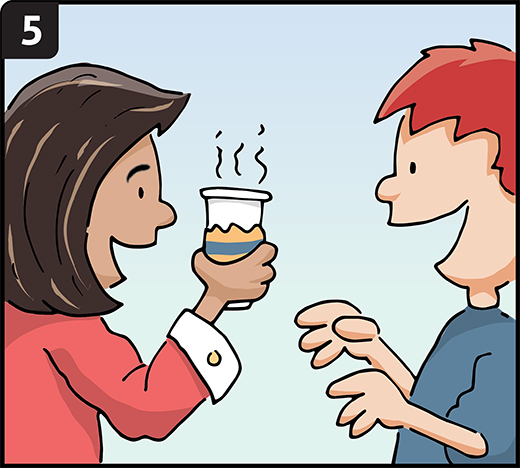
Build it. Try it. Evaluate it. Improve it.
◀ It’s rare for a design to work on the first try. In the case of the cup sleeve, the size, shape, and material would have to be tried, tested, revised, and tried again.
STEP 5
Share what you’ve done.
In 1991, Jay Sorenson shared his idea for cup sleeves. Today, almost a billion of them are used every year. The design process is how they came into being. ▶

Kids Discover talked about the design process with engineer Charles Anoff.
KD: Please tell us about a project you’ve worked on.
Anoff: One project was a distillation tower. We created a tower to cool air so the different chemicals like oxygen and carbon dioxide condensed and formed liquids.
KD: Did you use the design process?
Anoff: Absolutely. We researched other towers, made drawings, built a model, tested it, revised it, retested it, and so on.
KD: What’s the most important part of the process?
Anoff: Revising. We test and revise and test and revise until we get it right.
KD: Isn’t that discouraging?
Anoff: Not really, because the satisfaction is so great when you get it right.
KD: I’ve heard you say that art plays a role in the design process.
Anoff: As engineers, we don’t always think about projects as art, but many end up that way. Like the Eiffel Tower or the Golden Gate Bridge. The complexity, the lines, the shape. These things make a structure beautiful and pleasing to the eye. Certainly, that’s one definition of art.