Free
Want to cut a sheet of paper in half, pry open a tin can, or pull a cord to open a curtain?
The objects you use to do these things are all products of engineering. In fact, engineering affects just about every aspect of life. And it’s as old as civilization itself.
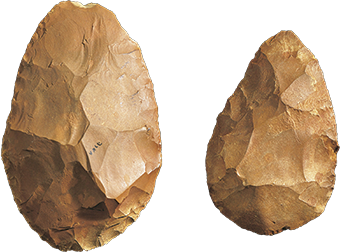
The very first engineers were solving problems more than a million years ago. Stone tools found in China and Kenya are the evidence. The problem was how to cut fruits, roots, vegetables, and meat. The solution? Strike stones together, causing sharp slivers of rock to break off. The stones with sharp edges were the tools, and today these tools are called wedges. Each time you cut food with a knife, you are using a wedge, one of the six simple machines. ▶
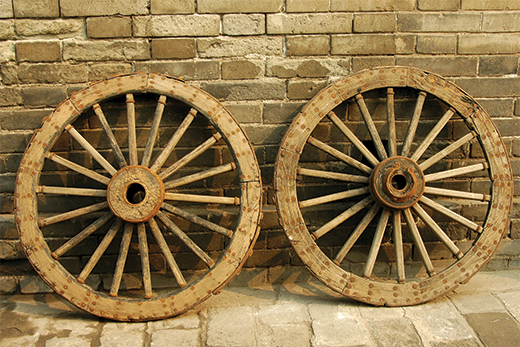
◀ You have probably pulled a wagon, pushed a shopping cart, or ridden a bike. If so, you can thank an ancient engineer. About 2,500 years ago, an engineer made it easier to move objects. The solution was a wheel and axle. The wheel and axle is a simple machine. It is a main part of cars, buses, bikes, carts, wagons, and more. The wheel itself — a circular object with a hole in the center — was around more than a thousand years before the wheel and axle. Evidence shows that the first wheels were made for potters. Originally, the potter turned the wheel by hand to help shape a pot and make its surface smooth. Today, potter’s wheels turn because of electric motors.
Loading the player...
▲ A very strong person may be able to lift a 450-pound stone. However, moving it from one place to another may be impossible. What if there were many stones in an otherwise open field? How could they be moved to clear the field? About 7,000 years ago, an engineer solved the problem. This person shoved a strong tree branch under an edge of a rock, pushed down on the tree branch, and rolled the rock forward. That was the first lever, another of the six simple machines. A couple thousand years later, this same tool was used to solve a different problem — fetching water from a river. The tool is called a shaduf and is still used today to irrigate land in Egypt, India, and other countries.
Ever since ancient times, people have needed to get across streams and rivers — a problem calling out for a solution. In places where large, flat stones were available, an ancient engineer used them to lay a path from one side of the water to the other. In places where timber was plentiful, ancients laid logs end to end across the water. Were they the world’s first engineers? Perhaps they were. ▶