Free
Many people played important roles in the events leading up to the Revolution and the outcome of the war. Here are some of them.
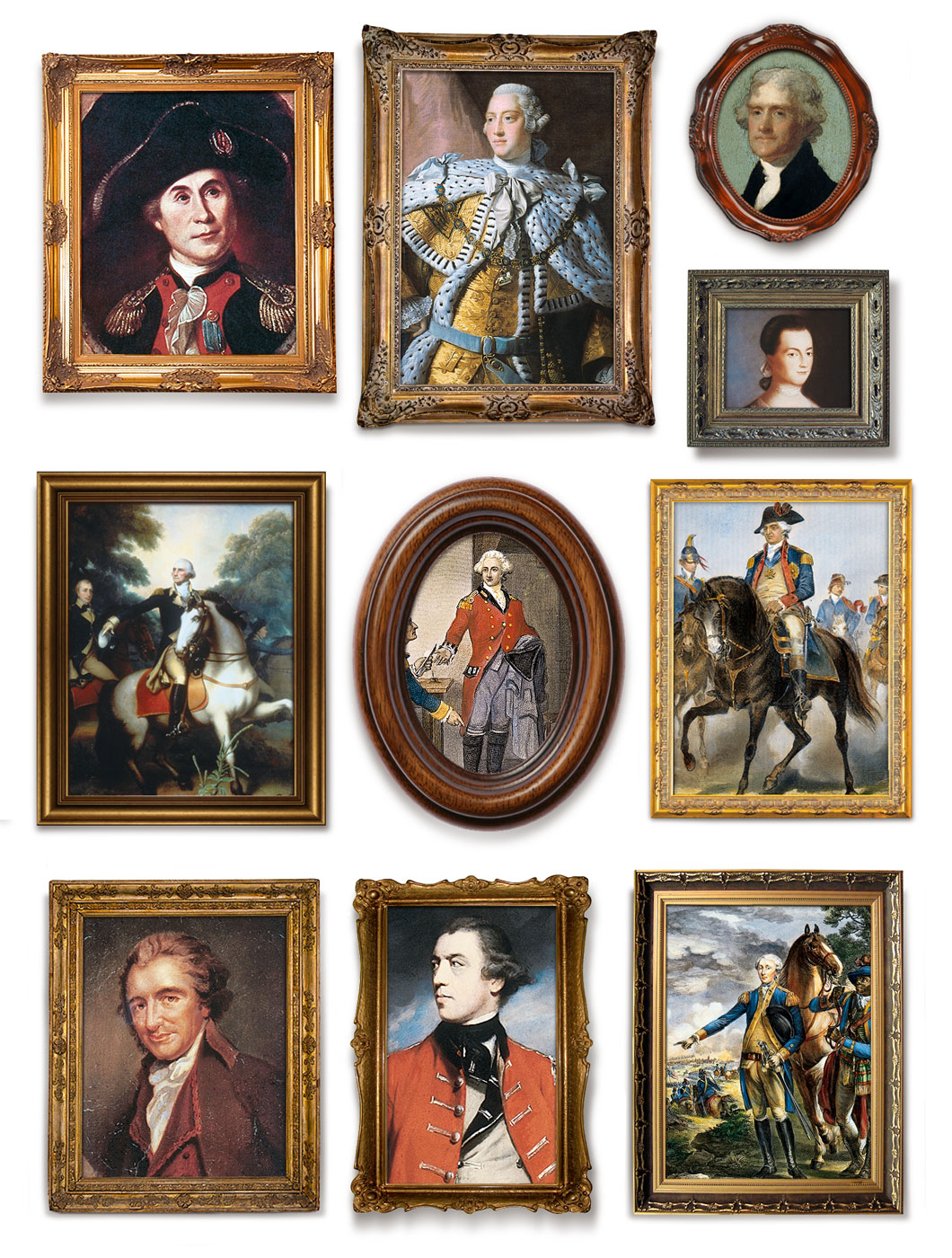
John Paul Jones (1747–1792)
When the Revolution broke out, Jones joined the Continental Navy. He was sent across the Atlantic to make problems for the British in their own waters. Jones captured 17 merchant ships and took more than 500 prisoners. One moonlit night, Jones’s Bonhomme Richard battled with the frigate Serapis. Asked if he was ready to surrender, Jones replied, “I have not yet begun to fight!” The battle raged on. In the end, it was the British captain who lost his nerve and surrendered.
King George III (1738–1820)
A king with only average ability, George III was very stubborn. He believed it was his duty to defeat the rebellious colonists. Early in 1782, it was clear that his opposition in Parliament had enough votes to end the war with the American colonists. George nearly stepped down as king. A trusted adviser persuaded him to remain. By 1811, George III was both insane and blind, and his son ruled in his place.
Thomas Jefferson (1743–1826)
Jefferson wrote and rewrote the Declaration of Independence many times before it was done. One time he changed fully one-third of the words in it. After writing this famous document, Jefferson was elected to two one-year terms as governor of Virginia. In 1781, he barely escaped capture by British troops. They later looted his home, burned crops, and killed livestock. They also made 30 of his slaves sick with smallpox so that they might spread the disease to the American troops.
Abigail Smith Adams (1744–1818)
Abigail Smith married John Adams in 1764. During the Revolution, when John was away from home for long periods of time, he and Abigail exchanged letters. Hers give a vivid portrait of the homefront and express her own revolutionary thinking. She was a firm supporter of independence and an outspoken foe of slavery. She was also a strong champion of women’s rights.
George Washington (1732–1799)
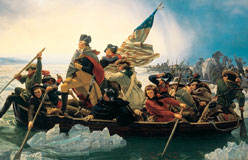
Most historians agree that without George Washington, the Patriots would have lost the Revolution. Washington wasn’t a military genius. But he was great at doing the most with what little he had. More important than Washington’s practicality, however, was his character. The general was courageous in battle, completely honest, and totally dedicated to the cause of independence. He was also a smart politician who kept 13 independent states united for one cause.
Benedict Arnold (1741–1801)
Brilliant Patriot or disgusting traitor? Arnold was actually both. In the early years of the war, he served the American cause with distinction. Arnold was put in charge of the fort at West Point, New York. When his second wife convinced him that he would make more money by working for the British, Arnold gave Major John André information that the British needed to conquer the fort. André was captured with the information and hanged. Arnold served with the British for the rest of the war and went to England afterward.
Friedrich Wilhelm Augustin, Baron von Steuben (1730–1794)
Born in Prussia (a German kingdom), Von Steuben took over the military training of the Continental Army in 1778. He wrote a book of regulations for the young army. Then he became its inspector general. He also took part in the siege of Yorktown in 1781. After the war, he stayed in America, becoming a citizen in 1783.
Thomas Paine (1737–1809)
Paine had a way with words that made people take action. In January 1776, several colonies were still undecided about declaring independence. Paine wrote a pamphlet called “Common Sense” that argued the case persuasively. Later, seeing the discouragement of the common soldier, he wrote “The Crisis.” It begins with the now-famous words, “These are the times that try men’s souls.”
John Burgoyne (1722–1792)
He was vain and bragged a lot, but General Burgoyne was also courageous. His troops called him Gentleman Johnny because he treated them well. In 1777 he came up with a plan to secure the Hudson River Valley for the British and isolate New England from the other colonies. The plan failed. Burgoyne was left alone in the Hudson Valley. On July 6, 1777, he captured Fort Ticonderoga, but he was soon forced to surrender at Saratoga.
Marie-Joseph-Paul-Yves-Roch-Gilbert du Motier, Marquis de Lafayette (1757–1834)
In the summer of 1777, an idealistic French nobleman came to America to fight for the cause of liberty. Lafayette and Washington soon formed a close bond. The soldiers under his command called Lafayette “the soldier's friend.” That’s because he spent his own money to buy them warm clothing. While in Virginia, Lafayette was lent a slave named Jim, who did some daring spying at Yorktown. Lafayette persuaded Virginia to give Jim his freedom. After the American Revolution, Lafayette helped start the French Revolution.